
Focal length
Measure of how strongly an optical system bends light.

cmglee, chensiyuan · CC BY-SA 4.0
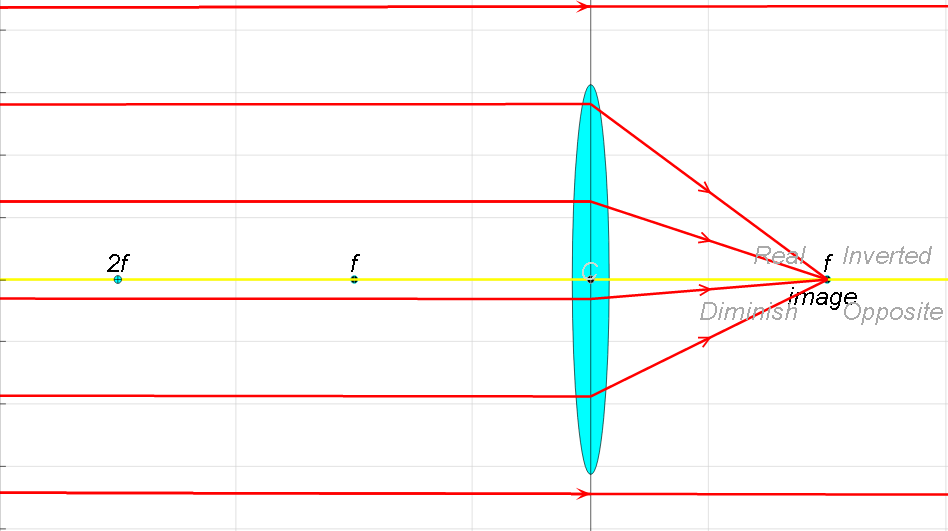
Focal length is a measure of how strongly an optical system converges or diverges light, expressed in units of length. For an idealized thin lens, it equals the distance between the lens and its focal points, with positive values indicating convergence and negative values indicating divergence.
- field
- Optics
- known_for
- Quantifying the convergence or divergence of light in optical systems
- units
- Length (e.g., meters, millimeters)
- positive_focal_length
- Converges light
- negative_focal_length
- Diverges light
Lore & Background
The focal length of a thin lens in air is the distance from the lens center to its principal foci. For a converging lens, this is the distance at which collimated light focuses to a spot; for a diverging lens, it is the distance to the point from which collimated light appears to diverge. The thin lens equation relates object distance, image distance, and focal length: 1/f = 1/u + 1/v. A convex lens's focal length can be measured by forming an image of a distant source on a screen, while a concave lens's focal length requires tracing the backward extension of dispersed light.
Reader's Guide
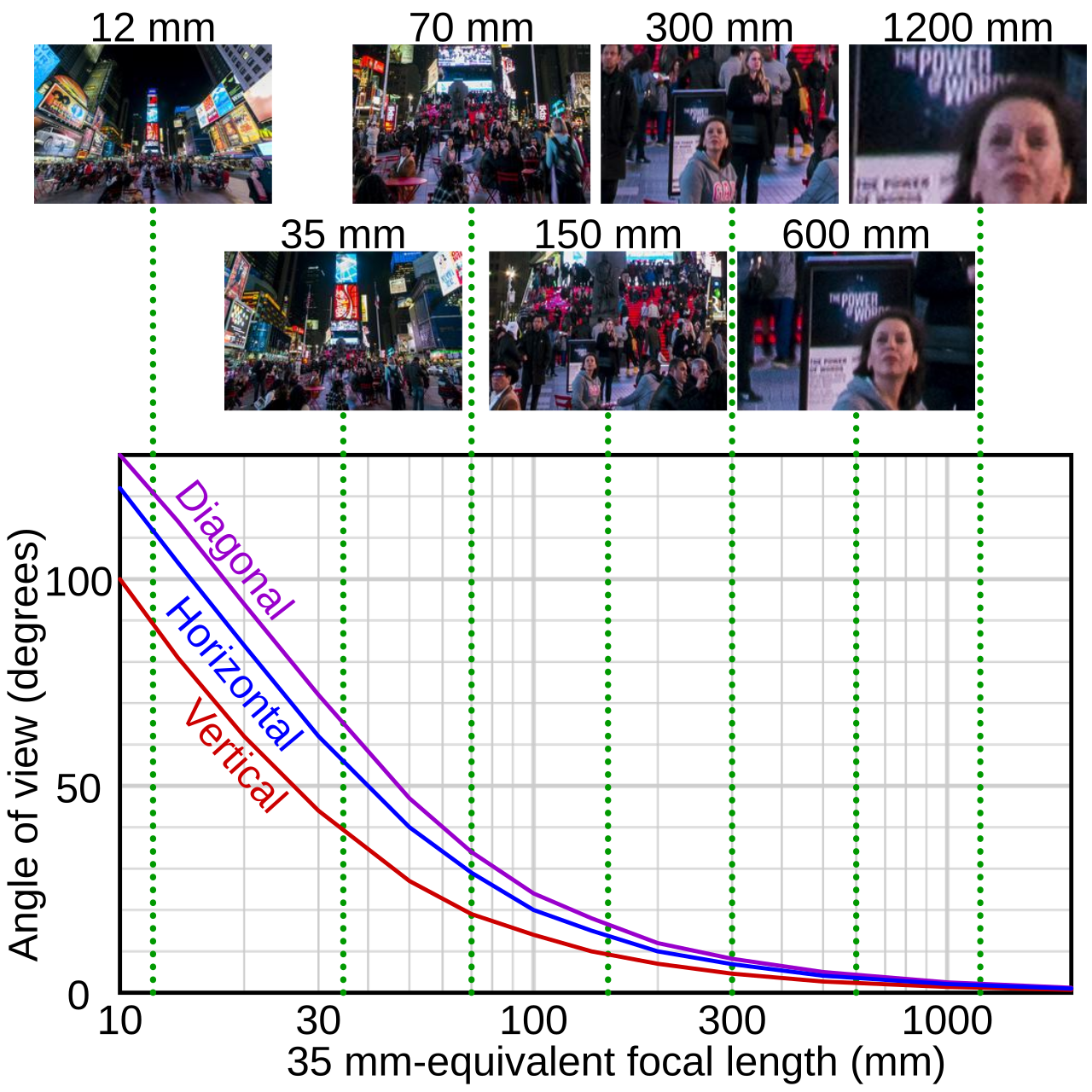
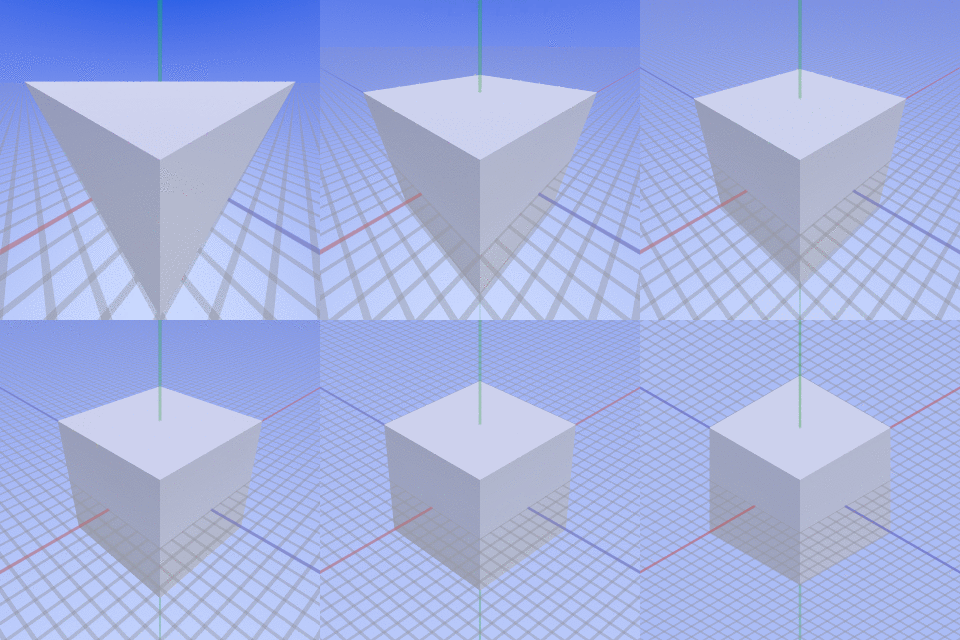
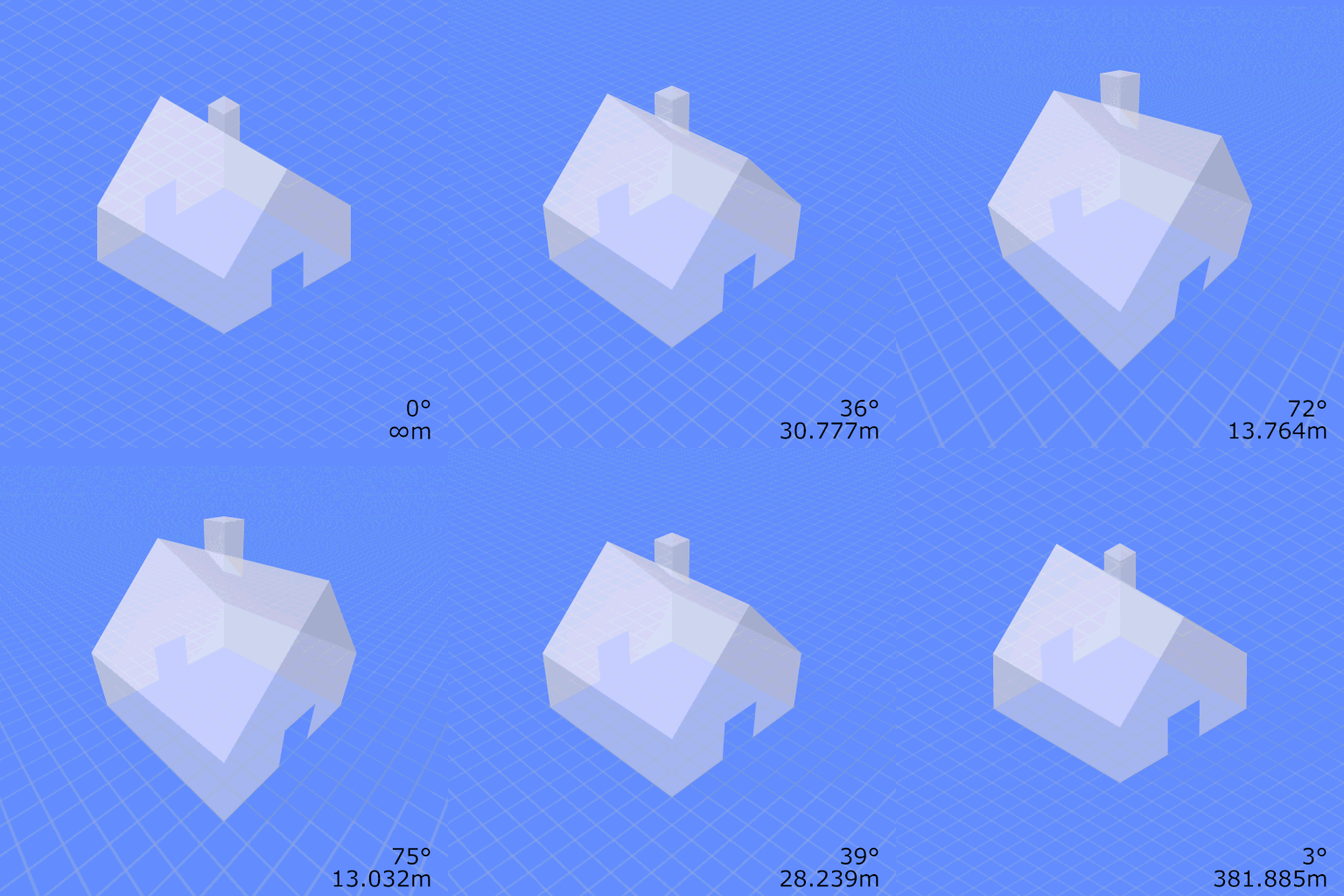
Focal length is fundamental to optics, determining magnification and angle of view. In photography and telescopy, longer focal lengths yield higher magnification and narrower angles of view; shorter focal lengths give wider angles. In microscopy, shorter focal lengths produce higher magnification by allowing the object to be brought closer. For general optical systems, focal length is the inverse of optical power. The effective focal length (EFL) models a system as an ideal thin lens. Front and rear focal lengths differ from EFL in media other than air, a distinction important for studying the human eye. The lensmaker's equation calculates EFL for a thick lens in air using refractive index, radii of curvature, and thickness.
Did You Know?
- A positive focal length indicates a system converges light; a negative focal length indicates divergence.
- For a thin convex lens, focal length can be measured by forming a sharp image of a distant light source on a screen, giving f ≈ v.
- The effective focal length (EFL) is the inverse of optical power and is used to calculate magnification.
- In a general optical system in air, the front focal length (FFL) and rear focal length (BFL) are not necessarily equal to the effective focal length (EFL); they differ if the principal planes are not at the lens surfaces
The Core Concept and Sign Convention
Focal length is the fundamental measure of how strongly an optical system bends light. Expressed in units of length, it captures whether a system pulls parallel rays together (positive focal length, converging) or spreads them apart (negative focal length, diverging). A shorter focal length means the rays are bent more sharply, reaching their focus over a shorter distance or diverging more rapidly. In the idealized case of a thin lens sitting in air, the focal length has a beautifully intuitive meaning: it is simply the distance from the lens center to the point where a bundle of parallel rays converges to a single spot, or conversely, the distance in front of the lens from which a point source must sit to produce a perfectly parallel beam after transmission. For more complex systems, however, this spatial intuition breaks down. The focal length no longer corresponds to a single physical distance you can point to; it becomes purely the reciprocal of the system's optical power, a mathematical quantity that still governs behavior but loses its simple geometric picture.
The Thin Lens Formula and Practical Measurement
When a thin lens in air forms an image, three quantities are locked together by a deceptively simple relationship: the reciprocal of the focal length equals the sum of the reciprocals of the object distance and the image distance. This elegant equation means that once any two of the three values are known, the third follows immediately. Measuring the focal length of a convex lens is straightforward in practice. You aim the lens at a distant light source, slide a screen behind it until a crisp image appears, and the distance from lens to screen gives you the focal length almost exactly, because the object distance is so large that its reciprocal becomes negligible. A concave lens, by contrast, refuses to form a real image on any screen. Its focal point is virtual, located on the incoming side of the lens. To pin down its value, you must pass a collimated beam—such as a laser—through the glass, observe how the beam fans out, and then trace those diverging rays backward to the point from which they appear to originate. That back-projected distance is the negative focal length.
Multiple Focal Lengths in Complex Systems
Once an optical system grows beyond a single thin element—think a multi-element photographic lens or a compound telescope—the single number 'focal length' fractures into several distinct but related quantities. The effective focal length is the reciprocal of the system's total optical power and is the value you use to compute magnification; it lets you replace the entire assembly with one ideal thin lens that behaves identically. The front focal length measures the gap between the front principal plane and the front focal point, while the rear focal length does the same on the opposite side. Two additional distances, the front focal distance and the back focal distance, measure from the actual first and last glass surfaces to the respective focal points, and some authors loosely call these 'front' or 'back focal lengths,' creating a nomenclature trap. In air or vacuum, where the refractive index is unity, all of these collapse to the same value and the ambiguity vanishes. In media with different refractive indices on either side, however, the front and rear focal lengths scale by those indices, and the bare term 'focal length' becomes genuinely ambiguous unless convention or context specifies which quantity is meant.
Magnification, Angle of View, and the Microscopy Twist
In photography and telescopy, where the subject sits effectively at infinity, the relationship between focal length and the resulting image is almost counterintuitive at first. A longer focal length, corresponding to lower optical power, yields greater magnification and a narrower field of view, while a shorter focal length gives a wider angle but less enlargement. This is the logic behind telephoto and wide-angle lenses in everyday photography. Microscopy, however, inverts the intuition. Because a microscope achieves its magnification by placing the specimen extremely close to the objective lens, a shorter focal length—higher optical power—actually produces greater magnification. The subject can be brought nearer to the center of projection, and the steeper bending of light amplifies the image more. This distinction matters because it means the same numerical focal length does not carry the same practical implication across every optical discipline. A fifty-millimeter lens on a camera and a fifty-millimeter objective on a microscope serve fundamentally different roles, and the sign and magnitude of the focal length interact with the object distance in ways that a simple 'longer means more zoom' heuristic cannot capture.
Gallery


More in Optics And Color 1-15
Spotted an error? Know more?
This is a living reference — every entry is fact-audited, and reader corrections feed straight into our audit queue. Suggest an edit · See this site's audit record