
Optics
Branch of physics studying light and electromagnetic radiation.

OpticalSystem · Public domain
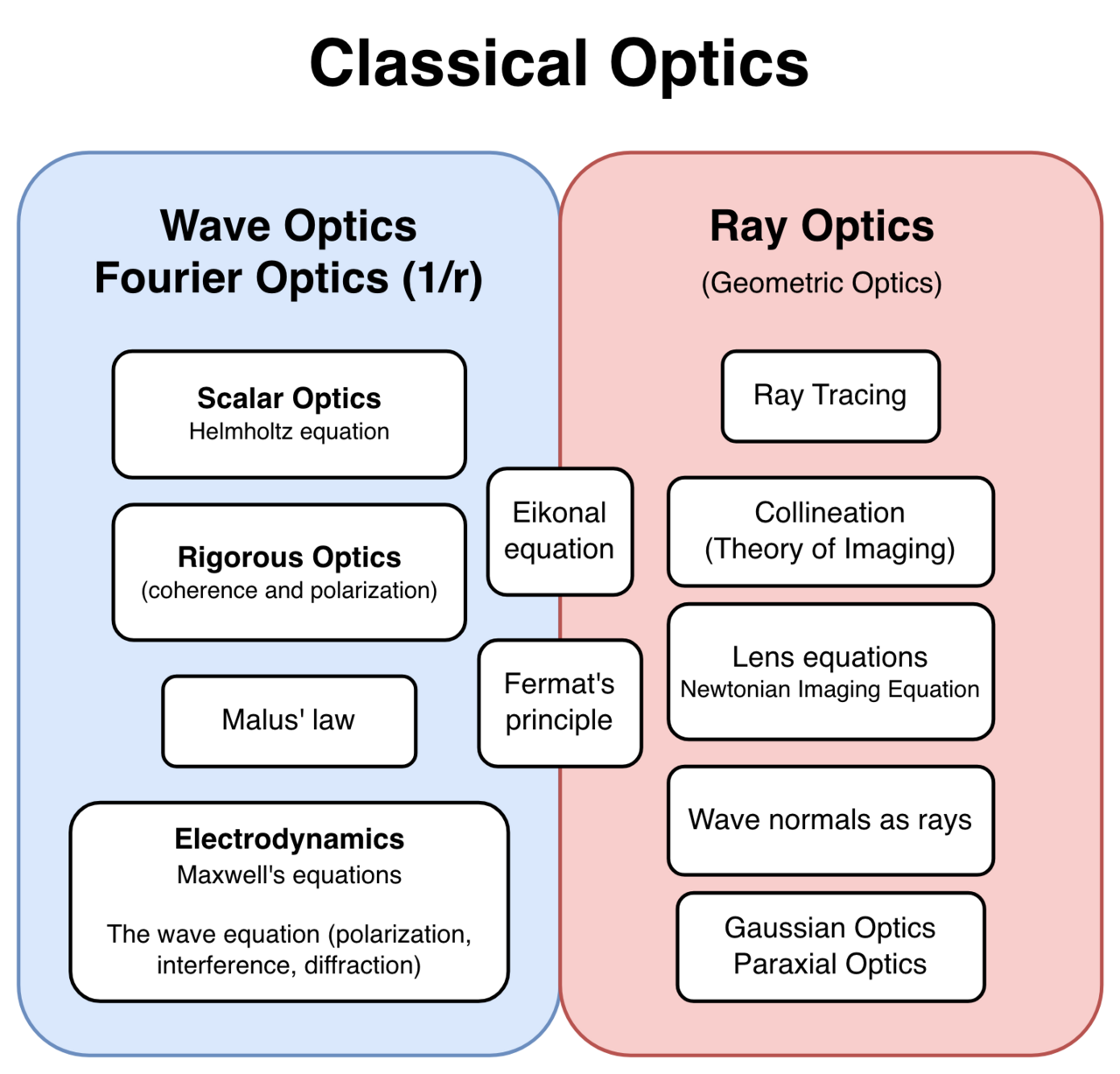
Optics is the branch of physics that studies the behaviour, manipulation, and detection of electromagnetic radiation, including its interactions with matter and instruments that use or detect it. It usually describes the behaviour of visible, ultraviolet, and infrared light, and extends to other forms of electromagnetic radiation such as radio waves, microwaves, and X-rays. The term optics is also applied to technology for manipulating beams of elementary charged particles.
- field
- Physics
- known_for
- Study of light, lenses, mirrors, telescopes, microscopes, and quantum optics
- earliest_known_lenses
- c. 2000 BC (Crete)
- key_historical_figures
- Euclid, Ptolemy, Alhazen, Kepler, Descartes
Lore & Background
Optics began with the development of lenses by the ancient Egyptians and Mesopotamians. The earliest known lenses, made from polished crystal, often quartz, date from as early as 2000 BC from Crete. The ancient Romans and Greeks filled glass spheres with water to make lenses. Greek philosophy on optics broke down into two opposing theories on how vision worked: the intromission theory and the emission theory. Euclid wrote a treatise entitled Optics where he linked vision to geometry, creating geometrical optics. Ptolemy held an extramission-intromission theory of vision and described a way to measure the angle of refraction.
Reader's Guide
During the Middle Ages, Greek ideas about optics were resurrected and extended by writers in the Muslim world. Alhazen wrote the Book of Optics, exploring reflection and refraction and proposing a new system for explaining vision and light based on observation and experiment. In the early 17th century, Johannes Kepler expanded on geometric optics, correctly deducing the role of the retina as the actual organ that recorded images. Optical theory progressed in the mid-17th century with treatises written by philosopher René Descartes. Practical applications of optics are found in mirrors, lenses, telescopes, microscopes, lasers, and fibre optics. Optical science is relevant to astronomy, engineering, photography, medicine, ophthalmology, and optometry.
Did You Know?
- The word optics comes from the ancient Greek word ὀπτική, optikē meaning 'appearance, look'.
- Alhazen rejected the emission theory of Ptolemaic optics and instead put forward the idea that light reflected in all directions in straight lines from all points of the objects being viewed.
Overturning Two Millennia of Assumption
For centuries, the dominant view of how sight worked was the extramission theory, championed by Euclid and Ptolemy. According to this model, the eye itself projected some kind of radiation outward toward whatever object a person was gazing at, and when those rays struck the object, the viewer could register its color, shape, and size. A competing but less dominant idea, traced to followers of Aristotle and Galen, suggested that some agent traveled from the object or its environment into the eye. Ibn al-Haytham dismantled the emission model with practical, observable arguments. He noted that staring directly at the sun can injure the eye, which would be inexplicable if the eye were merely sending out rays. He also argued it was implausible that the eye could flood the entire visible space the instant the eyelids opened, as one would experience when gazing up at the night sky. In its place he built a coherent intromission framework: every point on an object's surface emits light rays in all directions, and some of those rays inevitably enter the viewer's eye, making the object visible.
The Geometry of Seeing
A critical puzzle faced al-Haytham and his predecessors: if an object radiates light from every point on its surface in every direction, then the eye's outer surface should be struck by an overwhelming flood of rays from all those points simultaneously, producing a hopelessly blurred image rather than a sharp one. Al-Haytham resolved this dilemma through his theory of refraction. He reasoned that of the infinite rays traveling from a single point on the object toward the eye, only one arrives at a perfectly perpendicular angle to the eye's surface. All the remaining rays strike at oblique angles, and upon meeting the eye they are refracted and weakened, effectively removing them from the visual process. Only that single perpendicular ray contributes to what is seen. Within his anatomical model, the crystalline humor sits at the center of this process, receiving the light and forming a visual cone whose base is the perceived object and whose vertex is the center of the crystalline humor. The aqueous humor lies in front and the vitreous humor behind, though neither plays as decisive a role. The crystalline humor then relays the image to the brain via the optic nerve.
A New Framework for Light and Color
Al-Haytham introduced a layered taxonomy of light that had no direct precedent in earlier Greek or Arabic optics. He distinguished primary light, which emanates from self-luminous bodies such as the sun, from secondary or accidental light, which is produced when non-luminous objects receive illumination from those primary sources and re-radiate it. Crucially, secondary light cannot exist without a primary source. Both types travel in straight lines. He further classified bodies by their transparency: air and water transmit light but no material is perfectly transparent, while opaque objects block direct passage, though degrees of opaqueness govern how much light actually penetrates. When light strikes a smooth surface like a mirror it reflects in a straight line; when it passes through a partially transparent medium it refracts. Color, he argued, behaves much like light itself—it is a distinct quality of a form that radiates from every point of an object in straight lines. Through careful experimentation he also concluded that color cannot exist in the absence of air.
A Bridge to the European Scientific Revolution
The Book of Optics was composed in seven volumes spanning light, color, vision, reflection, and refraction, yet its most far-reaching impact came after it crossed into the Latin-speaking world. An unidentified scholar rendered the work into Latin at the close of the twelfth century or the opening of the thirteenth, making its arguments accessible to European natural philosophers. The text became a cornerstone of optical, physical, and mathematical inquiry across the continent from the thirteenth through the seventeenth centuries. That volume also contained a treatise on twilight mistakenly credited to Alhazen and an optical work by Vitello, underscoring how the text had become entangled in a wider European optical tradition. Modern scholarship, including A. I.
Gallery
More in Optics And Color 1-15
Spotted an error? Know more?
This is a living reference — every entry is fact-audited, and reader corrections feed straight into our audit queue. Suggest an edit · See this site's audit record