
Refractive index
Ratio of light speed in vacuum to that in a medium.

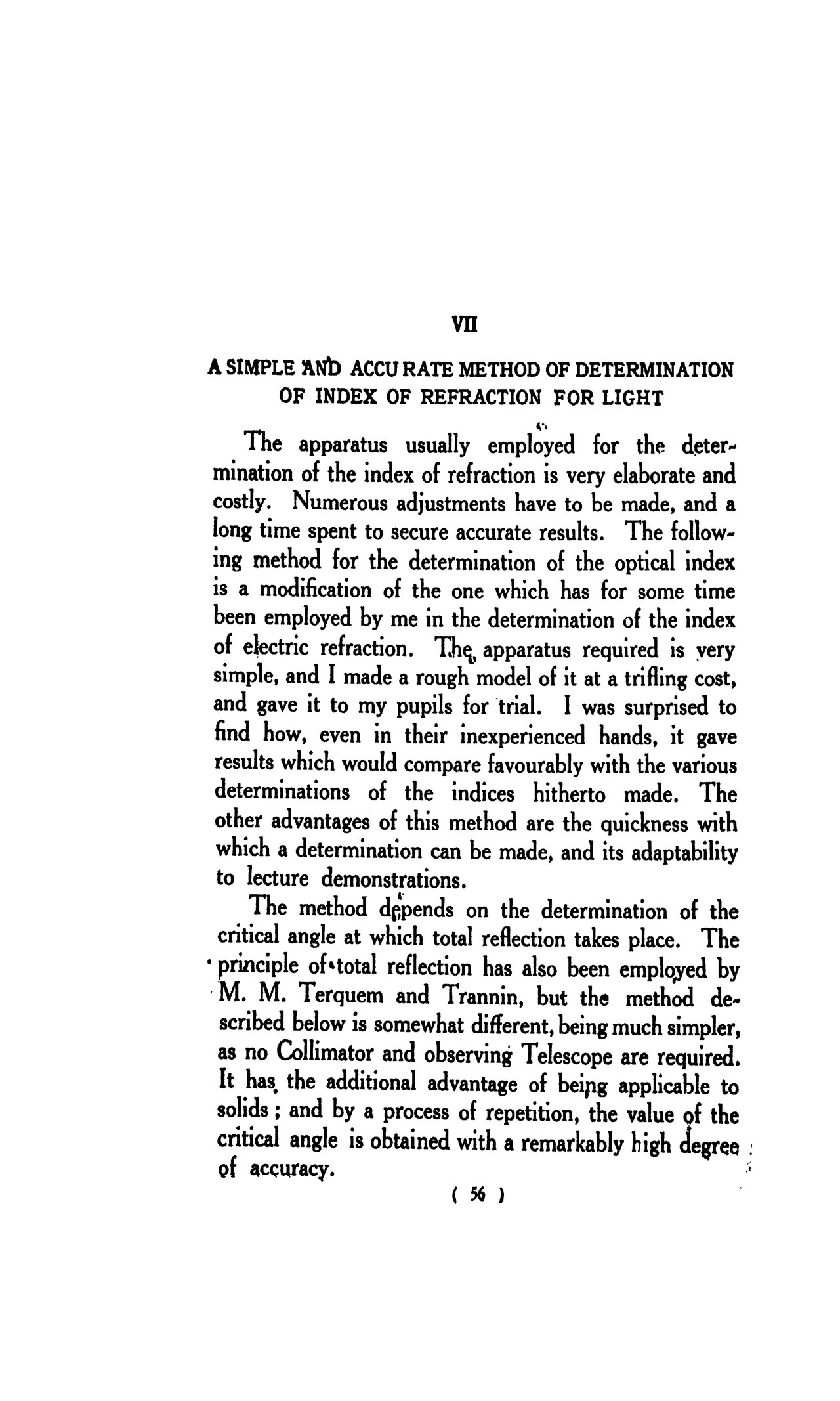
w:Jagadish Chandra Bose · Public domain
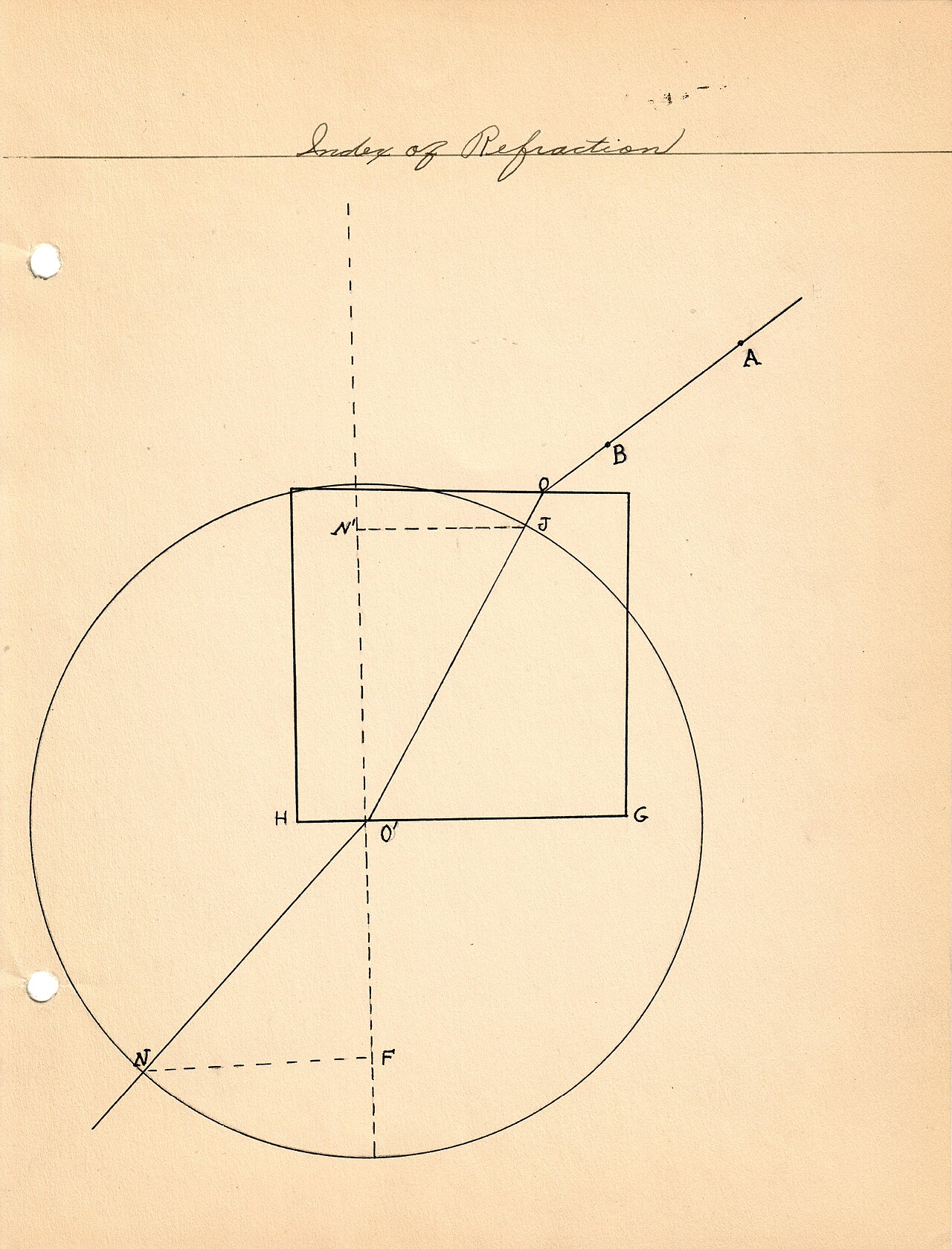
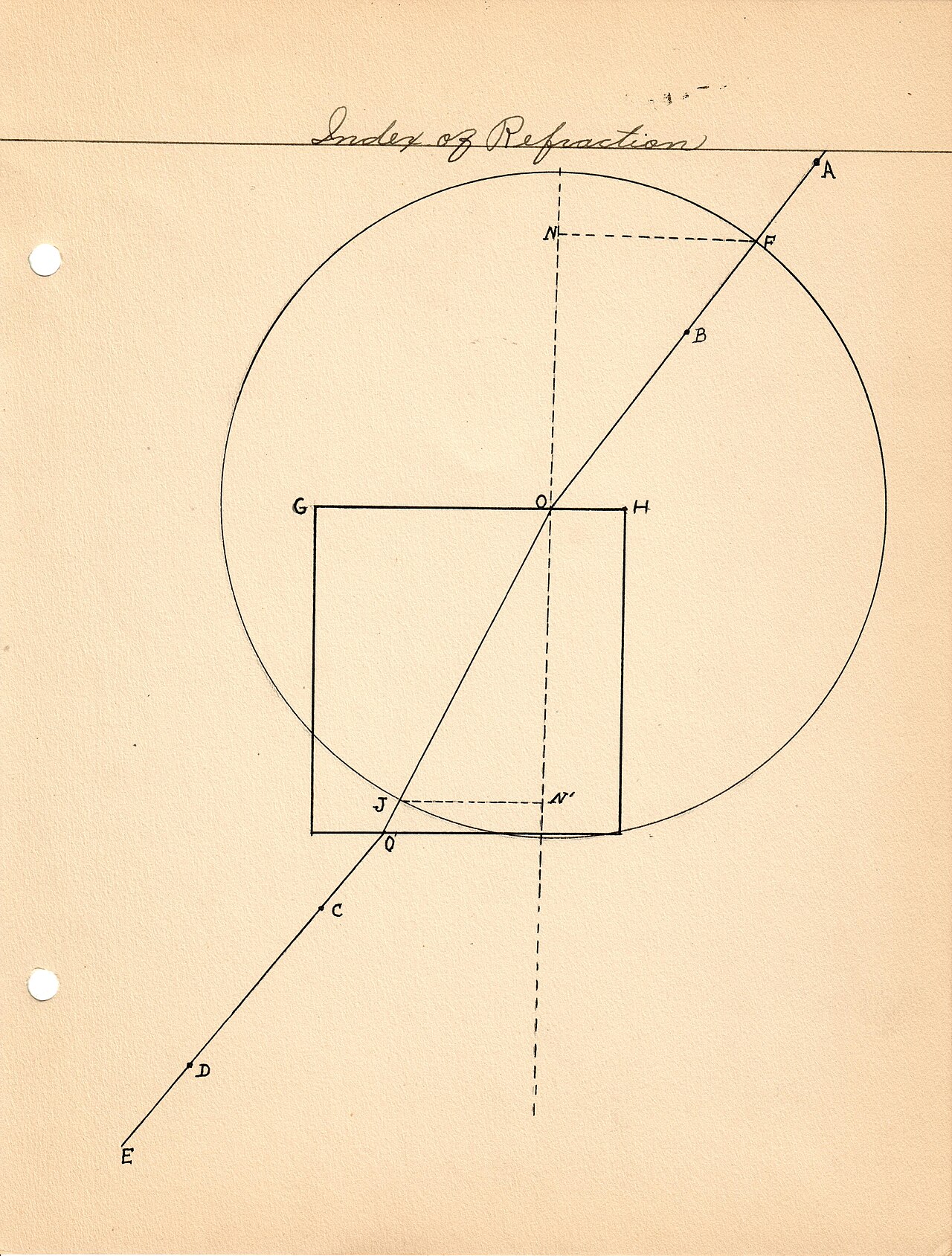
The refractive index (also called refraction index or index of refraction), often denoted n, is the ratio of the speed of light in vacuum (c) to the speed of light in a given optical medium (v), n=c/v. It determines how much the path of light is bent when entering a material, as described by Snell's law, and also affects reflection, total internal reflection, and Brewster's angle. The concept applies across the full electromagnetic spectrum and to wave phenomena such as sound.
- field
- Optics
- known_for
- Ratio of speed of light in vacuum to speed in a medium; determines refraction and dispersion
- symbol
- n (gradually prevailed over m and µ)
- typical_range_visible
- 1 to 2 for most transparent media
Lore & Background
Young did not use a symbol for the index; later others used n, m, and µ, with n gradually prevailing. The refractive index can be seen as the factor by which speed and wavelength are reduced relative to vacuum values: v = c/n and λ = λ0/n. It may vary with wavelength, causing dispersion—white light splitting into colors in prisms and rainbows, and chromatic aberration in lenses. For absorbing materials, a complex-valued refractive index is used, with the imaginary part handling attenuation. Historically, air at standardized pressure and temperature has commonly served as a reference medium. The relative refractive index of medium 2 with respect to medium 1 is n21 = v1/v2. If medium 1 is vacuum, the absolute refractive index is simply n = c/v.
Reader's Guide
The refractive index is a fundamental optical property that governs how light interacts with materials. It determines the bending of light at interfaces (Snell's law), the amount of reflection (Fresnel equations), and the critical angle for total internal reflection. Its variation with wavelength causes dispersion, essential for understanding prisms, rainbows, and chromatic aberration in lenses. In practical applications, high refractive index materials allow thinner, lighter lenses for eyeglasses. Plastics have lower refractive indices than glasses but are less dense, making them lighter. The concept extends beyond visible light to X-rays, radio waves, and even sound waves. Notably, refractive index can be less than 1 for phase velocities exceeding vacuum light speed, as occurs near resonance frequencies, in plasmas, and for X-rays. The historical development from Newton's ratio notation to Young's single-number index and the eventual adoption of the symbol n reflects a key step in standardizing optical science. Cauchy's equation provides a mathematical description of how refractive index varies with wavelength, typically using two or more terms.
Did You Know?
- Germanium has a refractive index of about 4 for infrared light from 2 to 14 μm.
The Core Physics of Light Bending
The refractive index, commonly written as n, sits at the heart of how light interacts with matter. At its simplest, it is the ratio of the speed of light in a vacuum to the speed at which light travels through a particular medium. Because the vacuum speed c is a fixed constant, the index is inversely proportional to the phase velocity in the material. This single number governs an extraordinary range of optical behavior: Snell's law uses it to predict the bending of a ray crossing an interface between two media, while the Fresnel equations rely on it to calculate how much light is reflected. It also sets the critical angle for total internal reflection and determines Brewster's angle, the incidence at which reflected light becomes fully polarized. In absorbing materials, the index takes on a complex form, where the real part handles refraction and the imaginary part accounts for attenuation. The frequency of the wave remains unchanged by the medium; instead, both the speed and the wavelength scale down by the same factor n, leaving the relationship f = v/λ intact.
Dispersion and the Wavelength Dependence
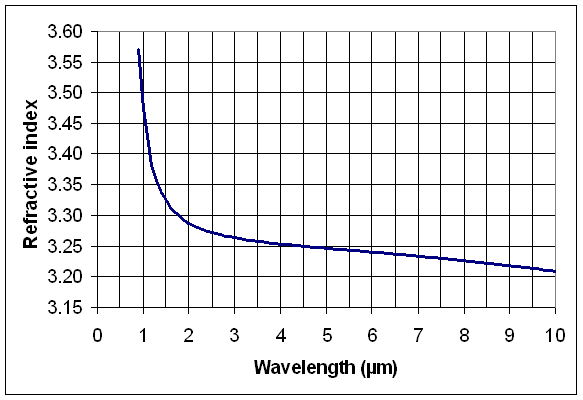
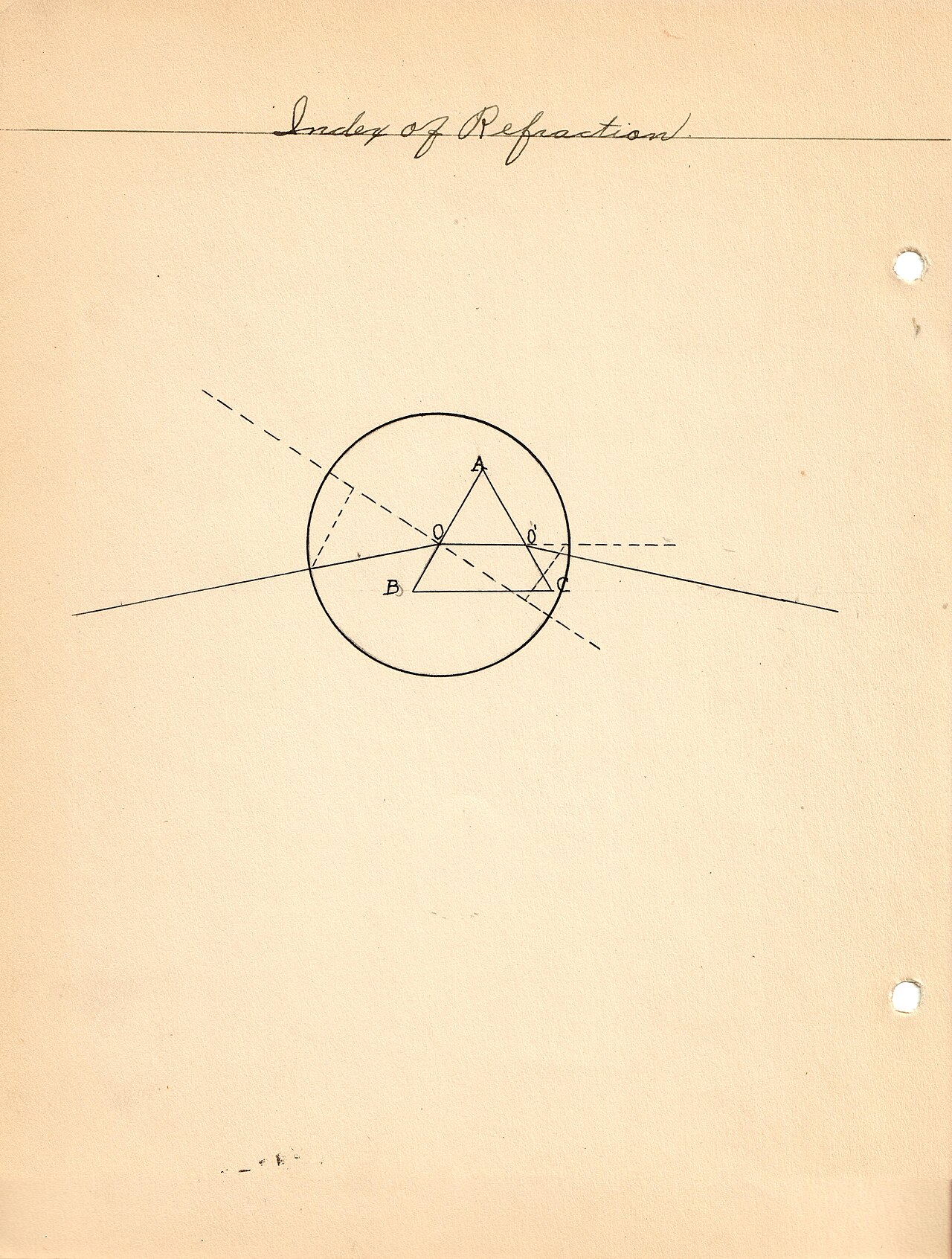
One of the most visually striking consequences of the refractive index is that it is not a single fixed number for a given material. The index shifts as the wavelength of light changes, a phenomenon known as dispersion. This wavelength sensitivity is what causes a glass prism to fan white light into a spectrum of colors, and it is the same physics behind rainbows and the colored fringes called chromatic aberration that plague imperfect lenses. For most common materials, the index changes by several percent across the visible spectrum, which means any single reported value of n must specify the wavelength at which it was measured. The relationship between n and wavelength can be captured by Cauchy's equation, a power series in inverse even powers of wavelength with material-specific coefficients A, B, C, and so on. In practice, a two-term version is often sufficient for engineering work. The coefficients are typically quoted using the vacuum wavelength expressed in micrometres, and they are determined by fitting the equation to measured refractive indices at known wavelengths.
A Brief History of the Name and the Symbol
Before Young, the concept was expressed inconsistently. In the years that followed, different authors adopted different letters—n, m, and µ—before n gradually won out as the standard notation. The shift from ratio to single number eliminated the notational confusion and gave the concept the clean, universal form it carries today.
From Eyeglasses to Ocean Waves
The refractive index is far more than a laboratory curiosity; it shapes everyday objects and natural phenomena alike. In optometry, a lens ground from high-index glass can be made noticeably thinner and lighter than a conventional low-index lens, an advantage that comes at a higher price. Plastics, while typically possessing lower refractive indices than glasses, are substantially less dense, which is why the lightest eyeglass lenses on the market have long been fabricated from plastic rather than glass. The concept also extends well beyond visible light. It applies across the entire electromagnetic spectrum, from X-rays to radio waves, and can even be adapted to acoustic wave phenomena, where the speed of sound replaces the speed of light and a reference medium other than vacuum must be chosen. In the natural world, refraction occurs in the ocean when light enters the halocline, the layer where salinity gradients alter water density and thereby change the effective refractive index of the column.
Gallery
More in Optics And Color 1-15
Spotted an error? Know more?
This is a living reference — every entry is fact-audited, and reader corrections feed straight into our audit queue. Suggest an edit · See this site's audit record