
Polarization (waves)
Property of transverse waves specifying oscillation orientation.

Polarization (or polarisation) is a property of transverse waves that specifies the geometrical orientation of their oscillations. In transverse waves, the direction of oscillation is perpendicular to the direction of wave motion, unlike longitudinal waves such as sound in fluids, which do not exhibit polarization. This property is fundamental to understanding electromagnetic waves like light and radio waves, gravitational waves, and transverse sound waves in solids.
- type
- Physical property
- field
- Optics, seismology, radio, microwaves
- key_waves
- Electromagnetic waves, gravitational waves, shear waves in solids
- polarization_types
- Linear, circular, elliptical
- quantum_aspect
- Photon spin (right-hand or left-hand)
Lore & Background
Polarization describes the orientation of oscillations in transverse waves, such as vibrations on a guitar string, which can be vertical, horizontal, or any direction in between. In contrast, longitudinal waves like sound in gases or liquids do not polarize because particle displacement aligns with propagation direction. Electromagnetic waves, including light, consist of coupled electric and magnetic fields perpendicular to each other and to the direction of travel; their polarization state depends on the relationship between these fields.
Reader's Guide
Polarization is a key parameter in technologies such as lasers, wireless and optical fiber telecommunications, and radar. Most common light sources, like the sun and incandescent lamps, emit unpolarized light—a mixture of wave trains with random polarizations. Passing such light through a polarizer yields polarized light. Certain materials, including those exhibiting birefringence, dichroism, or optical activity, affect light differently based on its polarization and are used to make polarizing filters. Reflection from a surface can also partially polarize light. In quantum mechanics, polarization corresponds to photon spin: circularly polarized light consists of photons with uniform spin direction, while linearly polarized light arises from a superposition of right- and left-handed spin states.
Did You Know?
- Longitudinal waves such as sound in liquids or gases do not exhibit polarization.
- Transverse waves that exhibit polarization include electromagnetic waves, gravitational waves, and shear waves in solids.
- Unpolarized light from sources like the sun consists of short wave trains with an equal mixture of polarizations.
- A photon has one of two possible spins: right-hand or left-hand sense about its direction of travel.
Why Only Transverse Waves Can Be Polarized
Polarization is a property that belongs exclusively to transverse waves—those in which the oscillation occurs perpendicular to the direction the wave travels. A simple illustration is a guitar string: depending on whether you pluck it vertically, horizontally, or at some intermediate angle, the vibrations orient themselves accordingly. This geometric freedom is what makes polarization meaningful. Longitudinal waves lack this freedom entirely. In sound waves propagating through air or water, particles are displaced back and forth along the very axis the wave moves, leaving no sideways orientation to specify. Consequently, such waves simply do not exhibit polarization. The transverse waves that do carry polarization span a remarkably wide range of physical phenomena. Electromagnetic radiation—visible light, radio waves—belongs here, as do gravitational waves and the shear sound waves that travel through solid materials. Each of these shares the defining feature: the oscillating quantity is oriented at right angles to the propagation direction, and that orientation is what we call the polarization.
The Geometry of Polarization States
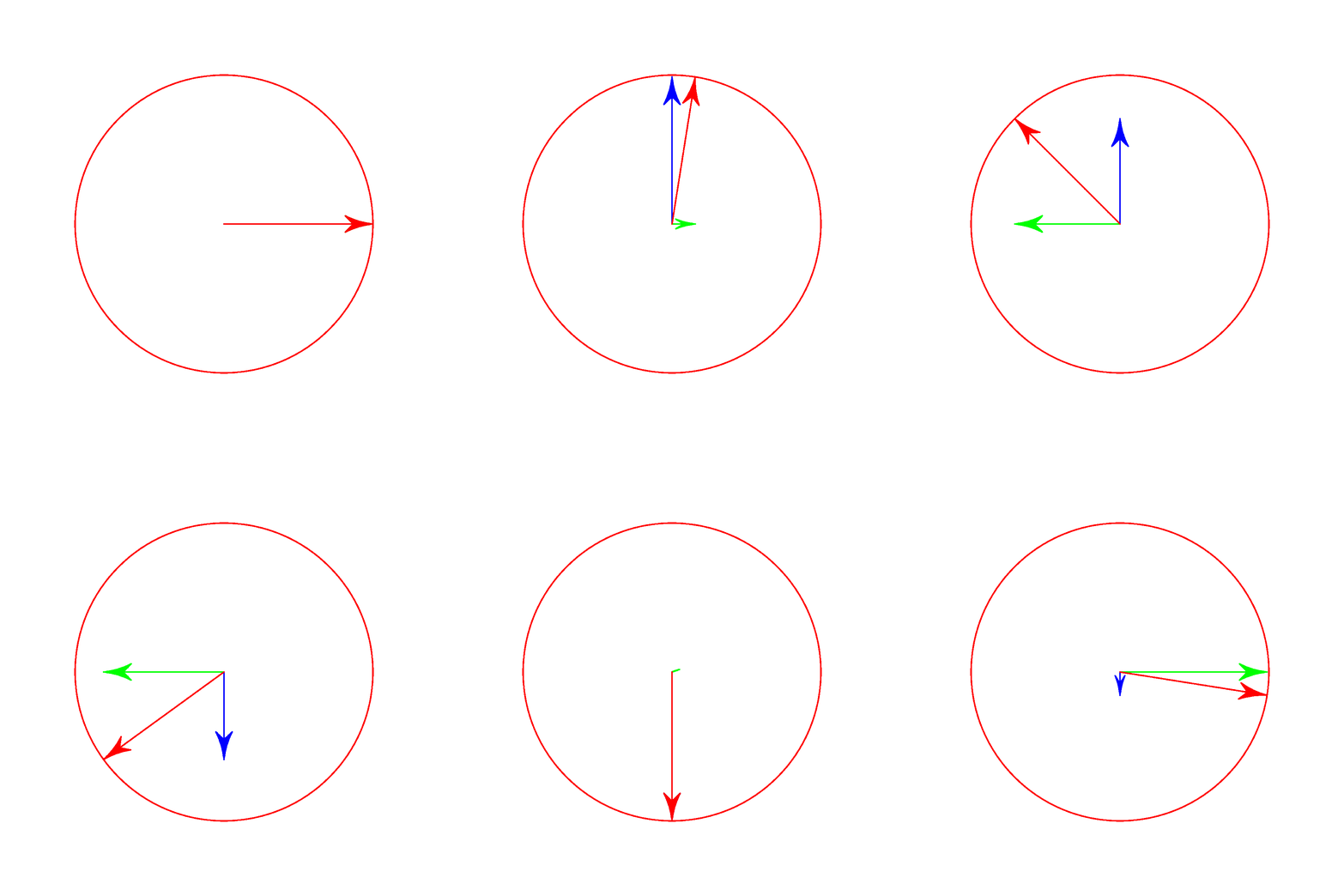
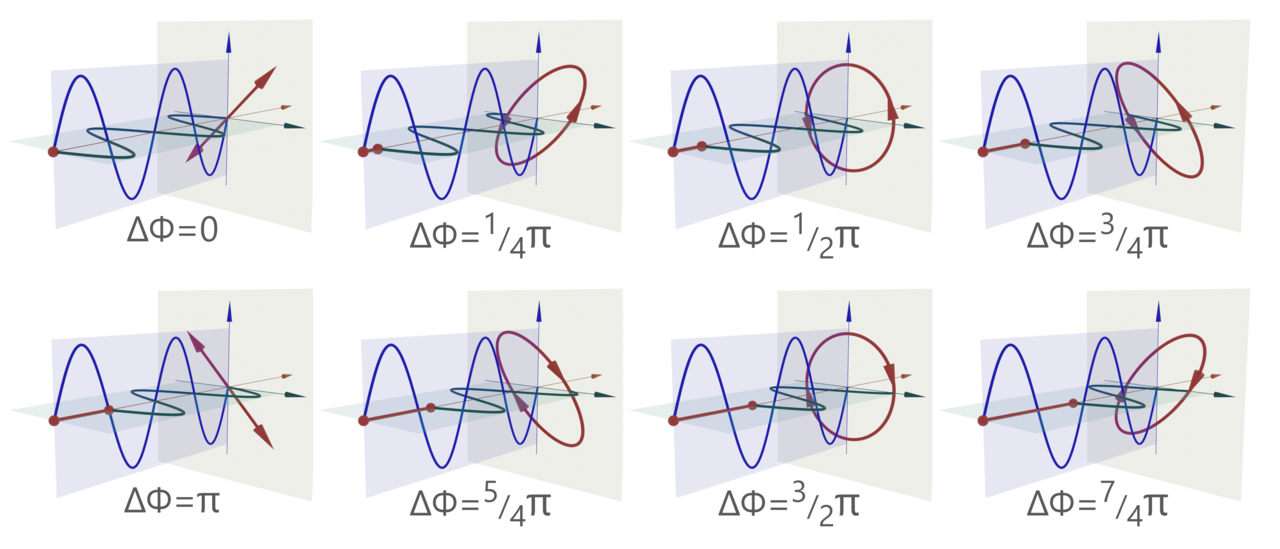
An electromagnetic wave in free space carries two coupled oscillating fields—an electric field and a magnetic field—that are always at right angles to each other and to the direction of travel. By convention, the polarization of the wave is identified with the orientation of the electric field vector. The simplest state is linear polarization, in which both fields oscillate back and forth along a single fixed axis perpendicular to the beam. More complex states arise when the field direction itself rotates as the wave advances. In circular polarization the tip of the electric field traces a perfect circle at a steady rate; in elliptical polarization it traces an ellipse. The rotation can proceed in a right-hand sense or a left-hand sense, giving two distinct circular states. These different polarization states are not merely academic distinctions. They correspond to genuinely different physical configurations of the coupled fields, and they interact differently with matter. A material that affects one polarization state may leave another untouched, a fact that underpins much of modern optical engineering.
From Unpolarized Chaos to Ordered Light
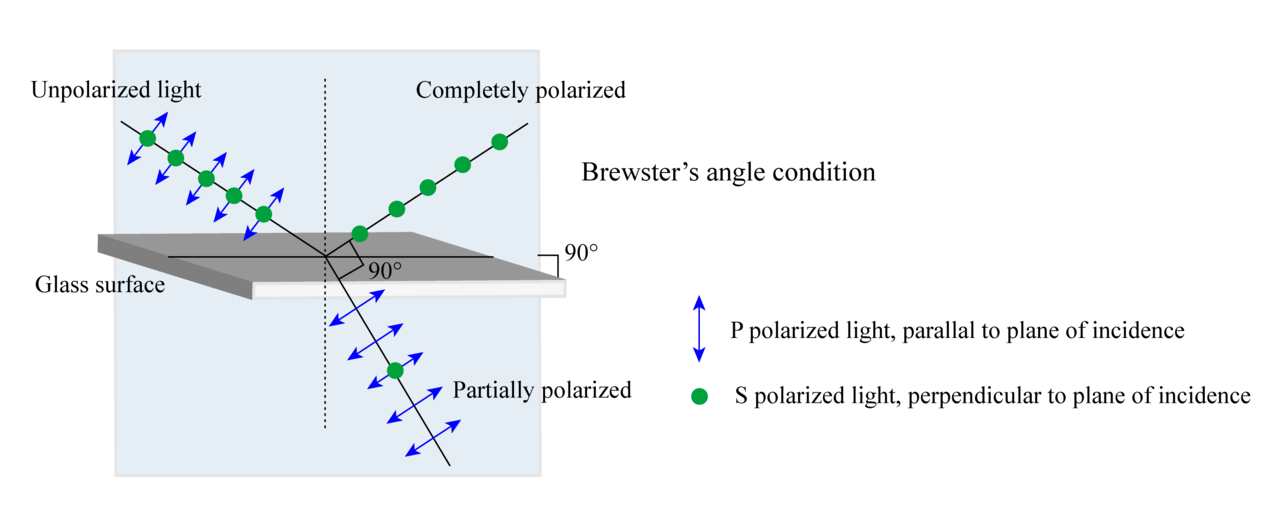
Most everyday light sources—the sun, a candle flame, an incandescent bulb—emit what we call unpolarized radiation. The emitted light is a jumble of short wave trains, each carrying a random polarization, so that no single orientation dominates. The result is an equal mixture of all possible polarization states. A polarizer is a device that selects only one polarization state and transmits it while blocking the rest, converting that chaotic mixture into clean, ordered polarized light. Beyond simple polarizers, certain materials interact with light in polarization-dependent ways. Birefringent crystals split or alter beams based on orientation; dichroic substances absorb one polarization more strongly than another; optically active media rotate the plane of polarization. These effects are exploited to build the polarizing filters found in sunglasses, camera lenses, and laboratory instruments. A subtler route to polarization is reflection. When light strikes a surface at a non-perpendicular angle, the reflected beam becomes partially polarized, with one orientation favored over others. This everyday phenomenon is the reason glare from water or glass surfaces can be reduced with a properly oriented polarizing filter.
Photons, Spin, and the Technologies That Depend on Polarization
Quantum mechanics reframes polarization in particle language. An electromagnetic wave can be understood as a stream of photons, and the polarization of the wave maps onto a quantum property of each photon called spin. A photon carries one of two possible spin orientations relative to its direction of travel: right-hand or left-hand. A beam of circularly polarized light consists entirely of photons sharing a single spin state—either all right-handed or all left-handed. Linearly polarized light, by contrast, is a superposition: each photon exists in a balanced combination of both spin states, with equal amplitudes and synchronized phases so that the collective oscillation locks into a single plane. This quantum description is not merely theoretical. Polarization is a critical parameter across optics, seismology, radio, and microwave science. Technologies that depend on controlling or detecting polarization include lasers, wireless communication systems, optical fiber telecommunications, and radar. In each case, the ability to manipulate the orientation of the oscillating field is what makes the technology work.
Gallery


More in Optics And Color 1-15
Spotted an error? Know more?
This is a living reference — every entry is fact-audited, and reader corrections feed straight into our audit queue. Suggest an edit · See this site's audit record